I’ve noticed a large challenge in keeping a garden blog is finding time outside the garden to actually write content for the blog. Maybe other garden bloggers have a plan of attack they wouldn’t mind sharing?
Content for today’s post is courtesy of Mom G’s August / September 2010 copy of Birds & Blooms magazine. Here’s a recipe created by Donna Hunt of Alabama for homemade suet for feathered friends that grace the garden.
1 cup lard
1 cup crunchy peanut butter
1 cup cooked oatmeal
1/2 cup sugar
1 cup crushed dried cereal
1/2 cup flower
The birds would probably even enjoy an addition of dried berries or a dash of different seeds. I’ll hand this over to my Other Half for further development.
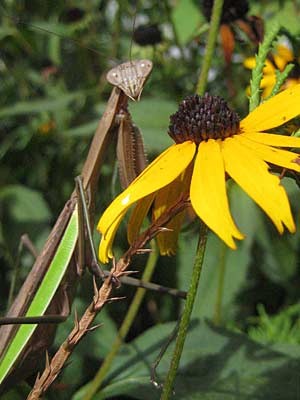
Okay, this is really cool. Today one of the four-legged garden staff found a new visitor to the garden. I noticed him hopping around and pawing at something on the ground. I put aside my garden snippers and walked over to see what he had found. Here it is.
Tenodera sinensis
As soon as I saw it was a praying mantis, I quickly snatched up my garden helper so the insect wouldn’t be harmed. This scared the mantis, who flew up out of the grass. That in turn freaked both myself and the feline-help out, with the cat leaping one direction and me shrieking like a little girl. After it was confirmed everyone was okay, I snuck over to the black-eyed susan where the insect had perched. Isn’t it gorgeous? This is the first time I’ve witnessed one of these visit The Lot.
The praying mantis is great, natural pest control for the garden. They make a buffet out such troublemakers as aphids, mites, and whiteflies. When I searched The Googles, I found our particular visitor was a Chinese Mantis (Tenodera sinensis). According to the National Geographic profile, these insects can also turn their heads from 180 to 360 degrees. Bizarre.
While snapping a whole series of pictures, I crept closer and closer to the mantis. Then it ever-so-slowly turned it’s head, without moving any other part of it’s body, to look at me. That’s when I shot the above picture and backed away to give it some privacy. I didn’t want to upset it. After all, it may know this guy.
Kale is a cool weather crop. We planted our kale plants behind the snow peas in the northwest corner of one of our two 4’x4′ raised beds. By the time the snow peas faded from the summer heat, the tomatoes (on the southeast side of the snowpeas) were tall enough to offer the Kale the same protection from the intense afternoon sun. The Kale receives dappled morning sun, a brief hit of noon sun, is then in light shade because of the neighbor’s tree and finally in full shade from our fence on the west side of the Lot. We are up to our ears in kale right now. Next year we will be planting two kale plants instead of four.
Like romaine lettuce, kale can be harvested througout the season without removing the whole plant from the garden. Simply remove the outer leaves as they develop, taking care not to disturb the budding center/top of the plant. Leave at least 4 to 6 leaves so the plant can nourish itself as it continues to grow. Larger leaves are great in soups, while the smaller (younger) leaves can be used in salads. I read that kale tastes even better after the first frost because it has a sweeter, more intense flavor.
Anyway, I consulted all-recipes.com to find dishes with kale in the ingredients list. Tonight we tried one of the two recipes I found, using kale, peppers and thai basil from our garden. We tweaked the recipe a bit. The original recipe can be found here. This is the way we prepared the dish.
Sweet Pepper Pasta Toss with Kale
Ingredients:
1 (8 ounce) package orzo
1 tablespoon olive oil
1 medium red bell pepper, chopped
1 medium yellow bell pepper, chopped
2 cups roughly chopped kale
2 cloves garlic, minced
1/4 cup loosely packed fresh thai basil
1 pinch crushed red pepper
salt to taste
4 ounces feta cheese, crumbled
Directions:
Bring a large pot of water to a boil. Add pasta and cook for 8 to 10 minutes or until al dente; drain.
Heat oil in a skillet over medium heat. Stir in red pepper, yellow pepper, and garlic. Cook 3 to 5 minutes.
Add kale and basil. Cook until kale is wilted.
Season with crushed red pepper and salt.
In a large bowl, toss cooked pasta with skillet mixture and feta cheese to serve.